LLM Agents That Evolve Without Rewards: World Knowledge Exploration Training (arXiv:2604.18131)
⏱️ Estimated reading time: 8 min
The Bottleneck in Reinforcement Learning
The standard method for adapting LLM agents to new environments is reinforcement learning. The agent takes an action, the environment returns a reward signal, and the agent updates its policy based on that signal. Intuitive, but expensive. Designing a reward function requires domain expertise, a separate function must be created for each environment, and thousands of exploration episodes are needed.
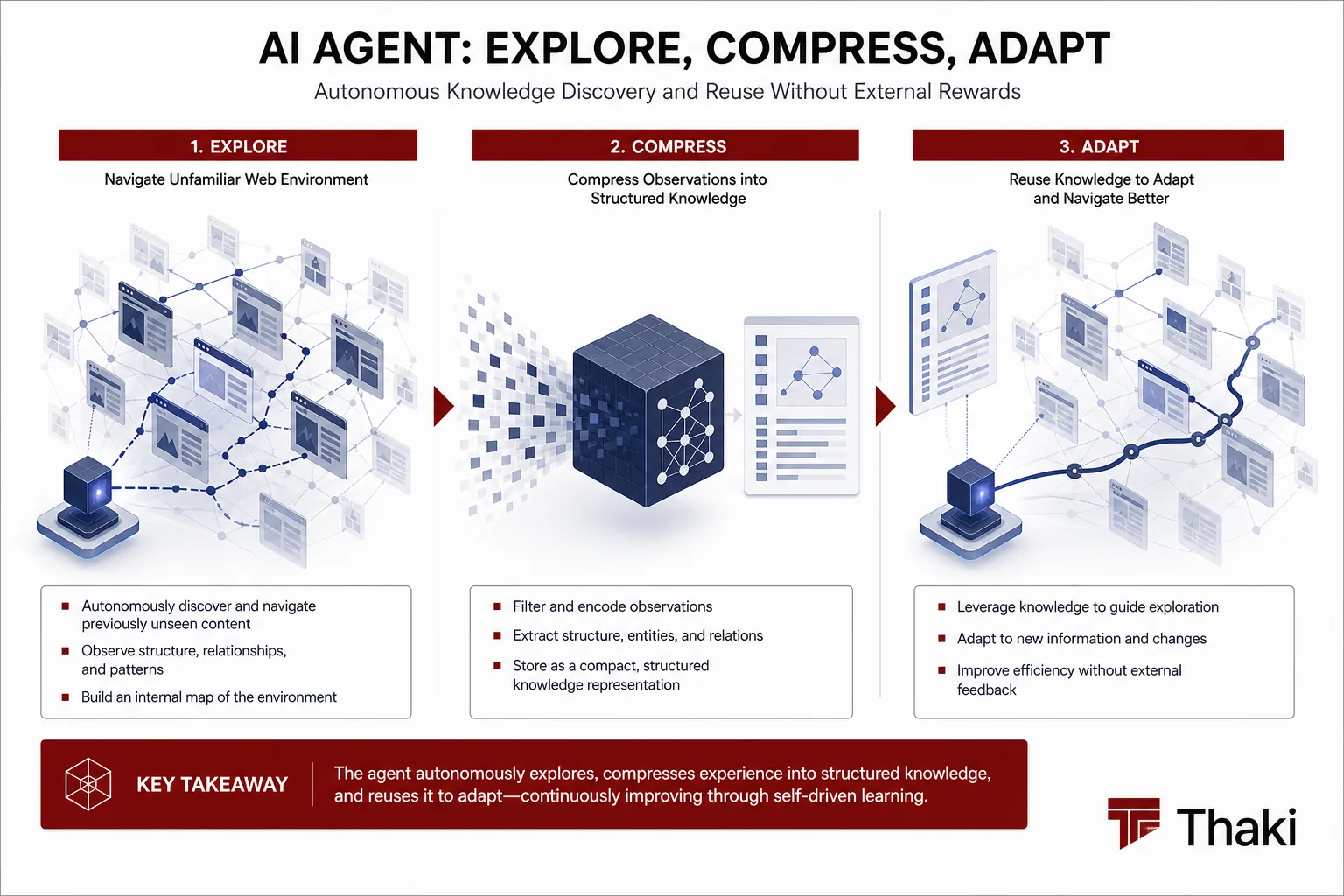
arXiv:2604.18131, “Training LLM Agents for Spontaneous, Reward-Free Self-Evolution via World Knowledge Exploration,” takes a different route around this bottleneck. It removes the external reward signal and instead uses how much the world knowledge generated by the agent itself improves downstream task performance as the training signal.
The Core Idea: Knowledge as the Reward
The paper starts from the assumption that a good agent has a good world model. To act appropriately in a new environment, accurate knowledge of that environment is required. Given that, could the quality of knowledge the agent self-generates by exploring an environment serve as the training signal?
Concretely, the outcome-based reward mechanism the paper proposes works as follows. The agent explores the environment and generates world knowledge autonomously. How well that knowledge enables the agent to perform downstream tasks is measured. That measurement becomes the training signal. No human-designed reward function is needed.
After training, the agent can carry out spontaneous self-evolution using only its internal parameters. The cycle of exploring a new environment, generating knowledge, and then acting on that knowledge runs without external intervention.
Experimental Results: Performance in Numbers
Two results from the paper stand out.
20% gain on web tasks: Agents trained with this method achieved a 20% performance improvement over baselines on web-based tasks. The web environment is a challenging domain for generalization because its structure varies and new UI patterns keep appearing. Achieving a 20% gain without a reward signal in this setting demonstrates practical utility.
Qwen3-14B surpassing Gemini-2.5-Flash: The more striking result. When Qwen3-14B (14 billion parameters) was trained with this method, it showed better performance than Gemini-2.5-Flash used without assistance. Given the difference in model scale, the effect of the methodology is significant.
Note that these figures are from the abstract, and for which benchmark and under what settings they were measured, the full paper should be consulted.
Why This Approach Matters
The contrast with existing agent adaptation methods makes the difference clear.
Fine-tuning requires large amounts of domain-specific data. Collecting data and retraining is a cycle that repeats every time you enter a new domain. Reinforcement learning requires reward function design and thousands of exploration episodes. Prompt engineering is fast but shallow.
The practical appeal of this paper’s method is that after training, it operates from parameters alone. From a serving infrastructure perspective, the agent adapts spontaneously to new environments without a separate reward function server or external evaluation API. This points toward reducing ongoing maintenance costs after agent deployment.
Limitations and Open Questions
The reason training without rewards is possible is that the world knowledge the agent generates is rich enough on its own. But in environments where knowledge generation quality is low, where exploration yields little meaningful information or environment feedback is dominated by noise, the training signal itself deteriorates.
It is also difficult from the abstract alone to understand under what conditions spontaneous self-evolution converges and under what conditions it diverges. How to monitor and control the self-evolution loop in actual production deployment will require further research and accumulated engineering experience.
ThakiCloud Platform Perspective
ThakiCloud’s AI platform operates agents across diverse customer environments. Designing a reward function and retraining for each environment is operationally expensive. If this paper’s methodology matures, deploying agents to new customer environments would open a path in which the agent figures out the environment and adapts itself with minimal configuration.
The web automation agent case is a direct reference point. Enterprise customers’ internal portals, SaaS tools, and legacy systems all have different structures. An agent that adapts to new web environments without reward signals is a deployable product in its own right.
In the near term, the practical experiment is fine-tuning a model at the scale of Qwen3-14B with this method and creating a domain-specific agent. If competitive performance can be achieved at a fraction of the serving cost of large models, that is a meaningful position from a cost-efficiency perspective.
Closing Thoughts
“An agent that evolves on its own without rewards” sounds idealistic, but this paper grounds the concept in specific mechanisms and experimental results. If the bottleneck in agent training is reward function design and exploration cost, this paper adds one more route around that bottleneck.
A 20% web task gain and a smaller model outperforming a larger one are numbers worth investigating. Reading the full paper is the next step toward understanding the generalization scope and limits of the methodology.
References
- Paper (arXiv): https://arxiv.org/abs/2604.18131
- GitHub: https://github.com/Bklight999/world-knowledge
- HuggingFace model: https://huggingface.co/Bklight999/World-Knowledge
The authors are affiliated with Tencent and the Hong Kong University of Science and Technology (Guangzhou). No separate dataset page or project page was found.