Builders, Owners, and Users Have Split: The Day the Number 20 Percent Appeared Twice
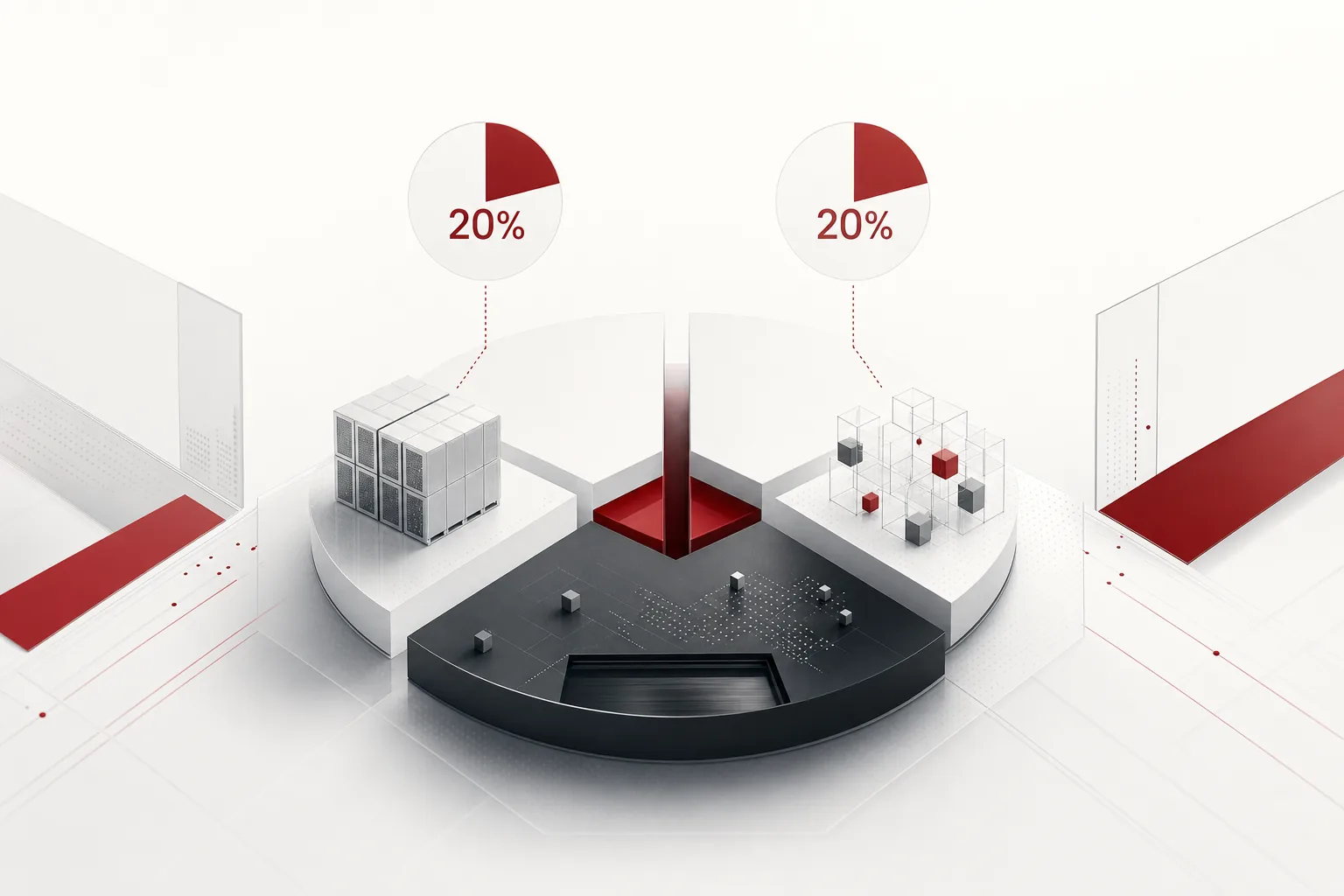 A visual representation of the article’s core concept.
The Number 20 Appeared Twice
The same number showed up in two data center deals announced between yesterday and today. Meta took only a 20 percent stake while building a $14 billion data center with BlackRock. Google secured roughly 20 percent equity in a project in exchange for guaranteeing the lease and power-purchase obligations of the Hubbard campus in Texas that Anthropic will use.
The directions are opposite. In one case, the company that will actually use the facility, under a lease running up to 20 years, gave up ownership. In the other, a company that will not use the facility gained ownership. Yet the outcomes converge on the same point: the entity that uses the computing, the entity that owns the asset, and the entity that is financially on the hook for it have split into three different names.
Reread through this lens, the stories in today’s digest, which seemed unrelated at first, line up into a single sentence: the AI infrastructure industry is right now unbundling ownership.
The Gigawatts That Vanish From the Balance Sheet
Break down the structure of the Meta deal and the intent becomes clear. Of the $14 billion total development cost, Meta contributed roughly $2.3 billion in kind, the land and the asset under construction, while a BlackRock-affiliated fund covers $4.9 billion in cash and $12.5 billion in debt financing. Meta will use the 1-gigawatt computing capacity starting in 2028, but on the books, the data center is not Meta’s.
The Google and Anthropic structure has one more layer of complexity. The developer, Nexus Data Centers, is raising $15 billion, about 21 trillion won, and a bank syndicate led by Morgan Stanley is providing $14 billion of that through a bridge loan and a revolving credit facility. That loan comes together not because of Anthropic’s own credit but because of Google’s guarantee. Even a company valued at $965 billion cannot build a mega-campus on its own cash flow, and instead borrows someone else’s credit to back its contractual obligations. Add in the 1.6-gigawatt natural gas power plant attached to the campus, and what’s being traded is no longer a building but a package that includes power and time.
Microsoft solves the same problem through accounting. Even after adding a projected $50 billion in third-quarter capex on top of $41 billion in second-quarter capex, the company kept free cash flow relatively solid, a result attributed to extending the depreciable life of data centers and office buildings from 15 to 25 years and treating a substantial share of its lease agreements as operating leases. The contrast is stark next to Alphabet turning free-cash-flow negative and Meta’s cash flow shrinking to roughly a tenth of its prior level.
All three cases say the same thing. If the burden of owning an asset can be separated from the right to use its computing, companies will gladly separate them.
Half of the 800 Megawatts Belongs to Someone Else
This same grammar has already arrived in Korea. Samsung SDS has set a target of more than 800 megawatts by 2031, and said more than 500 megawatts of that will be filled through an enterprise DBO model in which it does not directly own the assets: design, build, and operate, but not own. It’s a three-tier structure: Gumi is owned through direct investment, Korea AICC combines equity investment with operating outsourcing, and enterprise-customer data centers go the DBO route. Second-quarter cloud revenue of 779.4 billion won, with external revenue up 75 percent, shows this strategy is already being confirmed in the numbers.
On the other side stand the three telecom carriers. LG Uplus decided to put an additional 1.3489 trillion won into phase two of its Paju AIDC, which upon completion will hold 200 megawatts and about 70,000 Blackwell GPUs, with plans to expand to 600 megawatts by 2030. KT is targeting 1 gigawatt across roughly 20 sites nationwide with 5 trillion won over five years, and SK Telecom, through its newly established subsidiary SK Hyper, is aiming for 15 gigawatts by 2035. This is the direct approach: pour in capital and own the asset outright.
Two strategies are running side by side in the same market. One splits ownership to buy speed; the other holds onto ownership to buy control. Which is right can’t be judged yet. But one thing is certain from the customer’s side: it will keep getting harder to know who actually owns the building that houses the GPUs you’re using.
A case moving in the opposite direction surfaced the same day. Job postings for a server maintenance engineer and a construction general manager confirmed that DeepSeek is pursuing its own data center of up to 1 gigawatt in Ulanqab, Inner Mongolia, China. This is the first known case of the company, which had until now hired only research staff in Hangzhou and Beijing, publicly recruiting physical-infrastructure operations personnel. The calculation behind it is to cut cooling costs by relocating to an inland region with cheap power and low temperatures. It’s a story of a model company that had been renting cloud starting to build its own building once it grew large enough, and this pattern is likely to repeat among domestic customers too: the path of starting on managed services and reconsidering an on-premises shift once workload crosses a certain scale.
Someone Else’s Balance Sheet Sets Your Cost
When ownership is unbundled, pricing power scatters along with it. AWS posted $42.23 billion in second-quarter revenue, up 37 percent, its fastest quarter in four years, and CEO Andy Jassy said demand will be hard to meet in 2026 and 2027, and that 2028 demand is already very high. Microsoft Azure grew 43 percent and crossed $100 billion in annual revenue for the first time, and Google Cloud grew 82 percent. The AI bubble thesis was, at least by this quarter’s results, refuted.
In exchange, Amazon raised its annual capex to $220 billion and Alphabet to around $205 billion. Microsoft’s backlog rose 110 percent year over year to $625 billion, and Google Cloud posted a 35.6 percent operating margin. These numbers are evidence that the demand is real, and at the same time a measure of just how much money was poured in to meet it. That money eventually gets recovered from somewhere. With surveys showing that a good share of domestic companies plan to increase their AI budgets next year, the ones most dependent on global CSPs will be the first to feel the pressure of that cost being passed through.
Yet the opposite signal came from the model layer. OpenAI cut API pricing for its entry-level GPT-5.6 Luna by up to 80 percent, from $1 to $0.2 per million input tokens and from $6 to $1.2 per million output tokens. The mid-tier Terra was also cut by 20 percent, and the top-tier Sol kept its price but added a Fast mode up to 2.5 times faster. It reads as a response to Anthropic pricing Claude Opus 5 at half of Fable 5 just days earlier. Infrastructure costs are rising while token prices are falling.
Caught between these two curves are enterprise customers. Infrastructure cost and model cost move independently, driven by different companies’ financial strategies, and the swings arrive without warning, as seen in an 80 percent price cut just three weeks after a model’s launch.
What Ownership Still Doesn’t Control
So does owning the asset outright let you relax? Today’s policy stories draw a line against that expectation. As advanced semiconductors, HBM, lithography equipment, power, and rare earths get redefined as national security assets, bottlenecks have appeared across the entire AI value chain. Korea holds top-tier competitiveness in memory, but relies entirely on foreign sources for lithography equipment. Six US senators demanding that Apple pledge by August 21 not to use Chinese-made memory shows that even a purely operational decision like component sourcing has now entered the realm of diplomacy.
To sum it up: ownership has been unbundled, someone else sets the price, and politics shakes the supply chain. As the things you can’t control keep growing, knowing exactly where the points of control lie has become critical.
The Same Thing Is Repeating at the Agent Layer
Interestingly, today’s digest also includes a story showing this same structure reappearing at the software layer. Storage vendors are racing to roll out rollback capabilities that undo AI agent malfunctions. Ninety-four percent of IT leaders named data quality and pipeline integrity as the decisive factor in AI project success or failure, and GPU starvation, expensive GPUs sitting idle while waiting for data, was flagged as the new bottleneck. NetApp, Dell, IBM, Pure Storage, HPE, and Hitachi Vantara are competing along different axes.
Once an agent starts autonomously calling tools and changing state, the entity that executes and the entity that is responsible split apart, exactly the same split that happened in data centers. And the way to handle that split is the same too: control through contracts and records, not ownership. Storage vendors pushing immutable snapshots and continuous data protection ultimately means keeping a reversible state on hand like a contract. For Korean financial institutions bound by network separation and internal control requirements, getting approval to put an agent into production work is hard to clear without safeguards like these.
This is why ThakiCloud designed Paxis as an Agent-Native Cloud. Paxis treats Skills, Tools, Policies, and Audit Logs as first-class resources. A policy gate determines what an agent can do, an audit log records what it did, and execution itself happens inside an isolated sandbox. Dividing autonomy into levels from L0 to L3 follows the same logic. Being able to roll back at the moment you need to requires that what ran, when, and under what authority is already sitting there as a record.
Infrastructure is no different. The large-scale capacity that the three telecom carriers and Samsung SDS are building is close to bare metal, and a separate layer is still needed on top of it to provide multi-tenancy, GPU scheduling, and policy-based access control. The fact that more than 90 percent of the Nvidia B300 volume Samsung SDS brought in this March has already been put into customer service suggests that getting the layer ready to actually use that capacity is more urgent than the pace at which the capacity itself gets built. For customers with sovereignty requirements, whether this layer can run directly on top of on-premises Kubernetes is what decides whether adoption is even possible. CostRouter, which handles per-task model selection, is also a practical response to the token price volatility we just looked at. In a market where a given vendor’s pricing policy can change within three weeks, being able to swap models per workload amounts to negotiating leverage.
What to Hold Onto
Reduced to one sentence, today’s news says this: ownership in AI infrastructure is growing blurrier, and contracts, records, and policy are becoming the real substance of control instead.
Just as Meta secured 20 years of computing while handing 80 percent of its own data center to someone else, what a company needs to hold onto isn’t the asset itself but the contract that defines what it can do on top of that asset. The same principle applies to agents. You don’t need to own the model. But you do need to own the record of what that model did with your data.
These figures were compiled based on today’s domestic and international media coverage.
Sources
This article was compiled from the following news sources.
- Segye Ilbo, “Don’t Use Chinese-Made Memory”: US Congress Puts the Brakes on Apple’s Chinese Memory Adoption
- Seoul Economic Daily, To a Company Five Months Old With No Website, Intel Opened Its ‘30-Year Secret’
- Korea Economic Daily, AWS Posts Its Fastest Quarterly Growth in Four Years… “AI Demand Will Stay Strong Through 2028”
- Digital Today, Cloud’s ‘Big Three’ Post Record Growth Despite AI Bubble Talk, Keep Pushing Aggressive Infrastructure Investment
- Insight, Build Directly, Take Equity, Operate Instead: Samsung SDS’s Math Behind Its 800MW AI Infrastructure Plan
- EBN, After SKT and KT, LG Uplus Also Makes a ‘Trillion-Won-Scale Investment’… AIDC Dominance Race Intensifies
- Money Today, The Data Center Anthropic Will Use Negotiates a 21 Trillion Won Loan… Google Guarantees It Again
- Wikitree, Meta-BlackRock’s $14 Billion Data Center: Meta’s Stake Is Only 20%
- Yonhap News, DeepSeek Pushes to Build a Large-Scale AI Data Center in China’s Inner Mongolia
- ETNews, OpenAI Cuts Enterprise Pricing by Up to 80%, Joins the Price War
- IT Daily, [AI Storage 3] Rolling Back Even AI Agent Malfunctions… Global Vendors Clash
- Daily Post, Amorepacific Builds a Research-Focused Generative AI Platform
- News2Day, Korea Yokogawa Electric and VNTG Team Up to Support AI Adoption in Manufacturing… “Combining the Two Companies’ Capabilities”
- Edaily, A ‘Shopping AI’ That Even Gathers Feedback on Recommended Products Has Arrived
- CEO Score Daily, Deciding the ‘Top 3’ for ‘National Team AI’… LG, SKT, Upstage, and Motif Throw Their Hats In
- Yonhap News, AI Bottleneck Technology Becomes a Geopolitical Weapon… Nations Maneuver Through Shifting Alliances
- SBS Biz, [Market Briefing] Microsoft Reports Strong Earnings, Keeps This Year’s Capex Plan Unchanged
- IT Chosun, Cisco Open-Sources Weights for a Security-Focused AI, Expanding Its Own Model Strategy