The Week Washington Told Allies “Don’t Build Sovereign AI,” the World Ran Toward It
If you are a decision maker at an enterprise or public institution seriously weighing sovereign AI, this week’s news holds a paradox worth reading closely. In the very week the world’s strongest AI power told its allies through diplomatic channels not to build their own AI and to use its models instead, the market ran in exactly the opposite direction. The harder the pressure, the faster each country moved to build its own. Inside that mismatch sits the core of AI infrastructure strategy for the next several years.
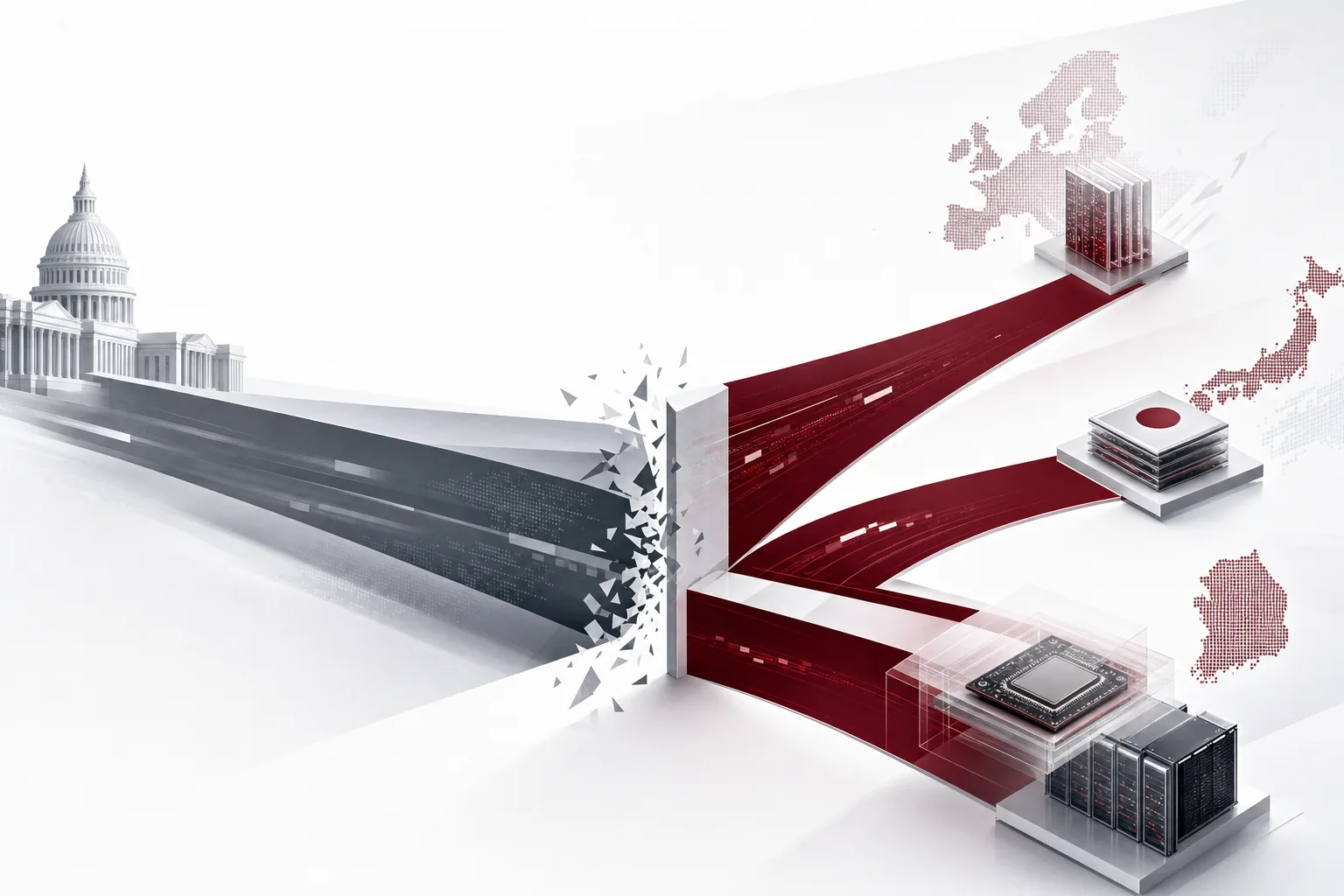 A depiction of this week’s core news flow.
Why Washington Said “Don’t”
According to Hankyung, the United States sent a diplomatic cable urging allied nations to hold back on building sovereign AI and instead adopt American AI models. The stated rationale is simple enough: it is an extension of the “AI Action Plan” aimed at cementing American models as the de facto global standard, and a check against the spread of Chinese AI models onto the international stage.
What stands out is the response. European officials pushed back directly, arguing they cannot build technology infrastructure that stays dependent on another government’s approval. Experts note that America’s history of economic coercion has already eroded trust, which is likely to blunt the effect of this round of persuasion. The core of this moment is that a directive does not automatically produce compliance, and that the directive itself provoked more wariness rather than less.
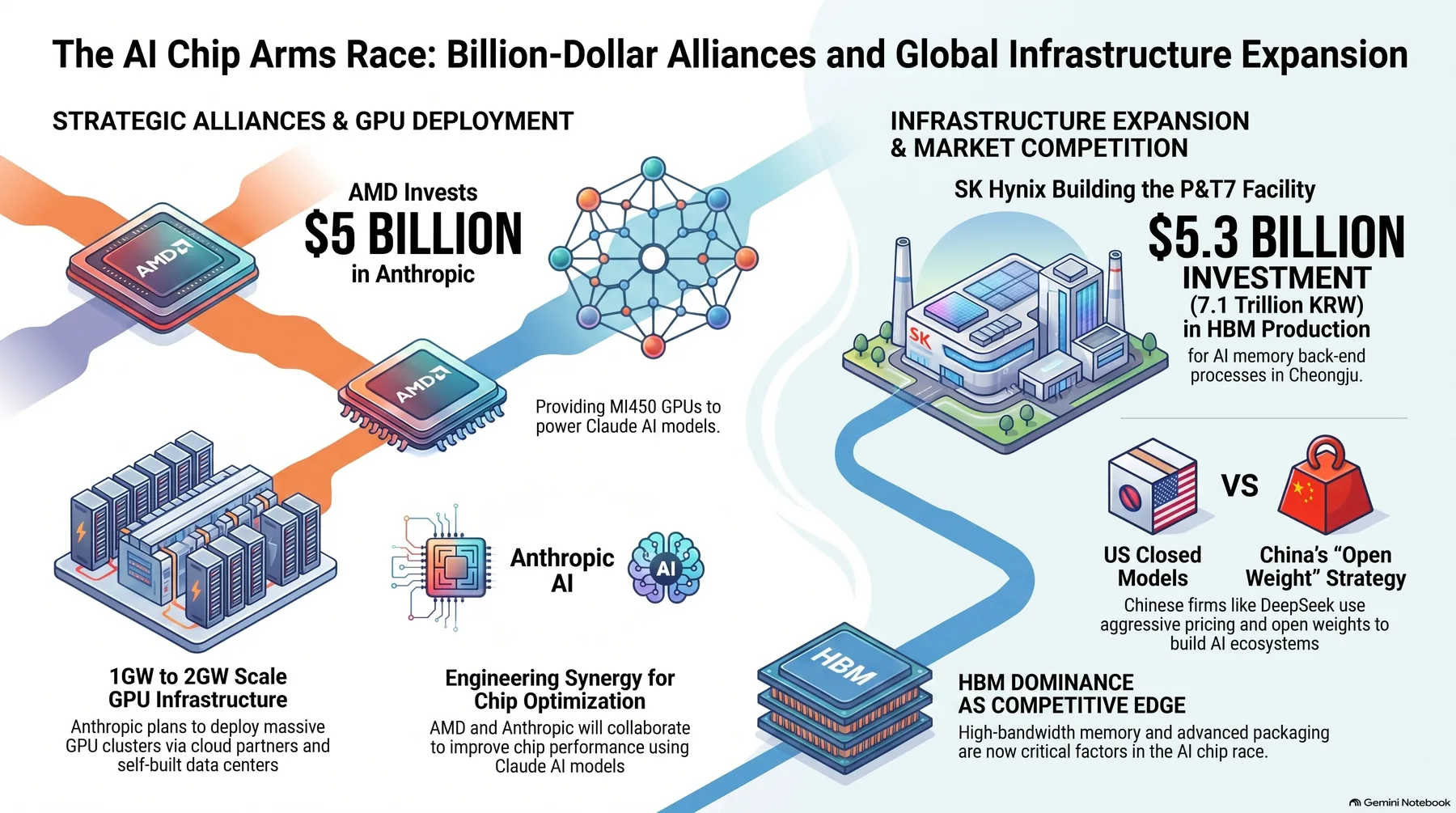 Infographic generated by NotebookLM from the sources.
But the Same Week Told a Different Story
Before the ink on the directive had dried, the market ran the other way.
The most striking scene is Samsung Electronics. According to Maeil Business Newspaper, Samsung invested roughly 1.7 trillion won in Mistral, Europe’s largest AI startup and the standard bearer for a “European alternative” to the Big Tech-centered ecosystem, signaling a strategic alliance. Mistral also supplies AI to France’s defense sector, making it the face of Europe’s sovereign AI camp. In the same week the US said “use ours,” Korea’s flagship company placed a bet on the opposing champion.
Japan went further and staged the move at the national level. According to Global Economic, Japan’s Ministry of Economy, Trade and Industry will invest roughly 3.4 trillion won in its first year through a newly established entity and the National Institute of Advanced Industrial Science and Technology, bringing together 44 companies including SoftBank, Honda, and Sony. The plan calls for procuring 27,500 NVIDIA Rubin-based AI chips with operations targeted for 2028, and it comes attached to a long-range blueprint of deploying 10 million AI robots by 2040. Having judged that it cannot chase the US and China head-on in models and data centers, Japan pivoted to claim its own standard on the physical AI front of robotics.
Korea’s government moved in the same direction. According to Maeil Ilbo, the government opened a competition backed by 16.9 billion won worth of GPUs to cultivate a homegrown, security-focused AI, with the winning team to be allocated national-scale GPU resources equivalent to 256 B200 units. The sovereign foundation model project reported by News1 has narrowed to a four-way contest among Upstage, LG AI Research, SK Telecom, and Motif Technologies, with the evaluation’s center of gravity shifting from raw performance to real-world applicability in public services, healthcare, manufacturing, and defense. SK Telecom signed a memorandum of understanding with the Ministry of National Defense, though observers note it has yet to fill even a tenth of defense demand, a sign of just how early this market still is.
Companies on the ground moved the same way. According to Medical Times, DEEPNOID secured 256 units of H200 GPUs through a government support program and is developing a 27-billion-parameter medical multimodal model, while JLK completed validation on GPU environments outside NVIDIA, running a parallel experiment to reduce vendor lock-in. Sovereignty was not a government slogan here. It was already becoming reality, measured in the development speed of individual companies that had secured their own GPUs.
The Real Reason No One Can Give Up Sovereignty
So why does every country insist on building its own, even in defiance of a direct instruction? The answer shows up in two other stories from the same week.
The first is trust. The controversy over “Kimi K3” distillation, covered by Datanet, exposed the risk of importing someone else’s model wholesale. Anthropic classified an incident in which a specific Chinese organization ran roughly 28.8 million interactions against its model using about 25,000 fake accounts as the largest distillation attack on record. The problem is that a model built this way can circulate with its safeguards stripped off. Adopting an opaque, unverified overseas open-weight model without scrutiny means importing jailbreak vulnerabilities and data-leakage paths along with it. The ability to select only verified models becomes part of what sovereignty means.
The second is infrastructure sustainability. The 2,440 trillion won in Big Tech shadow debt reported by Global Economic and the negative cash flow at Google Cloud noted by Korea Economic TV show that riding on someone else’s infrastructure is not automatically safe. Even as its cloud business grew 82 percent, Alphabet’s capital expenditure reached 115 percent of operating cash flow, pushing free cash flow negative, and the off-balance-sheet debt of five major US Big Tech firms has grown eightfold in four years. The Bank for International Settlements warned that if data center construction plans falter, the shock could spread across the entire market. Depending entirely on someone else’s infrastructure means inheriting that party’s financial risk along with it.
The reality that neither models nor infrastructure can be safely left entirely in someone else’s hands is the force pulling every country back toward sovereignty. The American directive could not overcome that force.
The Next Battlefield Is Not the Model. It Is the Agent.
One more signal needs to be added here. Byline Network covered the standards war over agentic commerce, where AI agents find products and complete payment on a person’s behalf, and put Korea’s remaining runway at roughly 12 months. The article identifies four protocol layers required for agent transactions and points out that Korea holds no stake in any of them. As Google and Meta join shared commerce specifications, the field is hardening, and the warning is that latecomers will be left absorbing compliance costs with no say in setting the agenda.
One concept worth watching here is KYA, a framework for verifying an agent’s identity and authority. It marks a shift from KYC, which verified people, to verifying agents instead. This is a signal that sovereignty is descending past models and GPUs down to the execution-authority layer of agents, and that without a stake at this layer, even a well-built domestic model ends up operating only within specifications someone else set. If model sovereignty is half the picture, the other half is the ability to define and control, on your own terms, what an agent is permitted to do.
Sovereignty Is a Control Capability, Not a Declaration
One thing needs to be made clear. Understanding sovereign AI as the declaration “we will use domestic models” only captures half of it. The real problem lives at execution. You need to know which model is running where, where that model came from, and you need the ability to control and log, on your own, what authority an agent used to do what it did, before sovereignty actually holds. If you cannot filter out distilled models, cannot audit execution history, or your procurement is locked into a single vendor, the label “domestic” is only a shell.
This is precisely why ThakiCloud designed Paxis as an agent-native cloud. Paxis treats skills, tools, policies, and audit logs as first-class resources. Its model catalog screens provenance and licensing to keep unverified open-weight models from entering the system. Agent execution is governed by policy gates tied to autonomy levels, and every action is recorded in an audit log. Running on-premises and on sovereign Kubernetes, it isolates execution so data never crosses borders, and it avoids lock-in to any single Big Tech provider by giving teams the choice of the right model for each task. The pain points this week’s news exposed, securing trustworthy models, data sovereignty, safe execution, and controlling procurement cost, are exactly the problems Paxis is built to address.
The week the American directive and the market’s countercurrent split apart was the moment sovereign AI dropped from a political slogan into an operational task. The direction is already set. What remains is a single question: will sovereignty be declared in words, or held in a form you can actually control? The answer to that question will shape enterprise AI strategy for years to come.
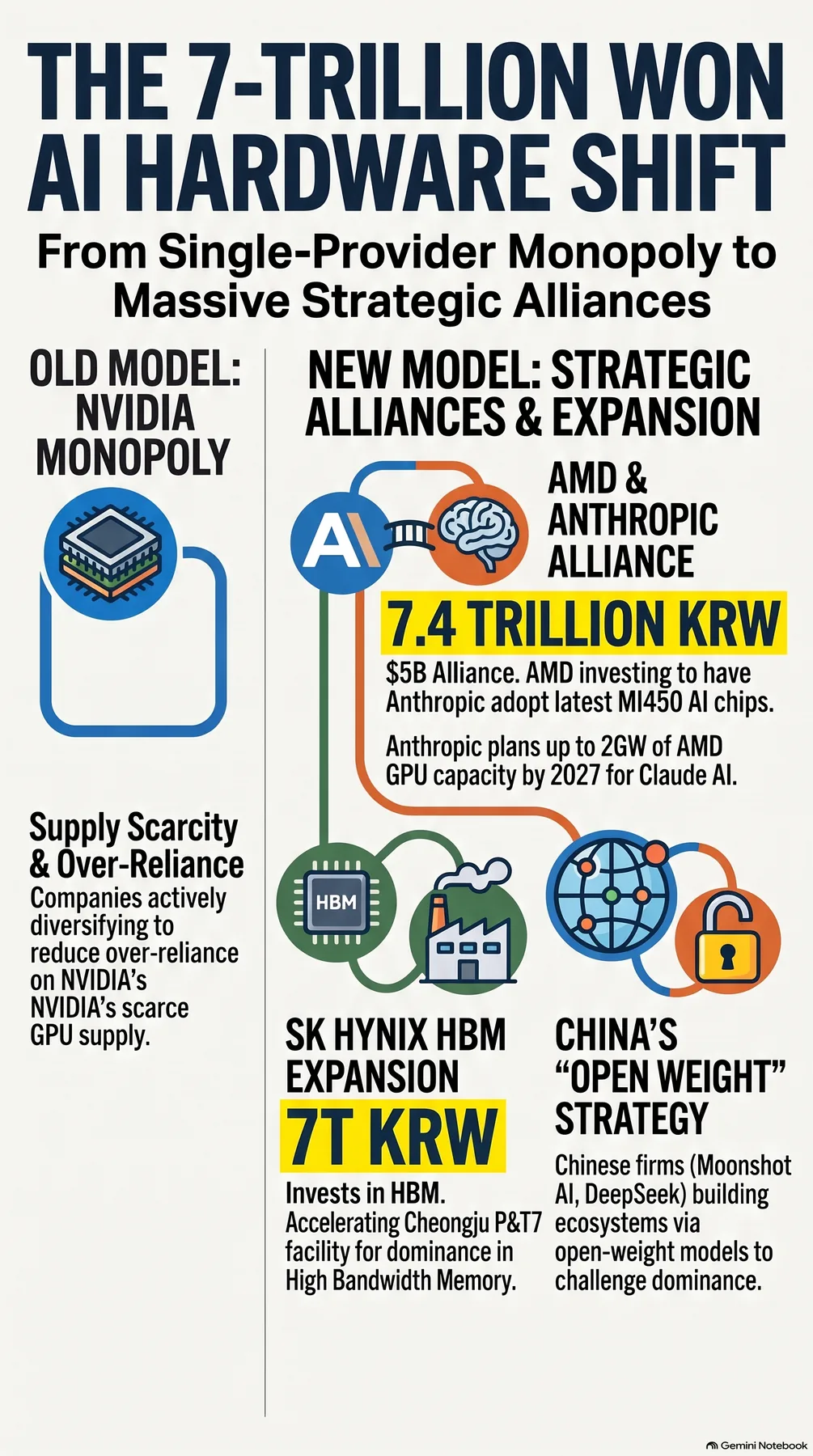 Infographic generated by NotebookLM from the sources.
Sources
This article was compiled from the following news reports.
- Mediafine, SK hynix, Cheongju P&T7 investment moves forward, 7.0931 trillion won deployed for AI memory demand
- Herald Corp, AMD invests up to 7 trillion won in Anthropic, forging an AI chip supply alliance
- Newspim, China Hardtech IPO Big Bang: Moonshot AI and DeepSeek advance, the challenge for Korean semiconductors
- Global Economic, Big Tech shadow debt reaches 2,440 trillion won, AI infrastructure credit risk emerges
- Korea Economic TV, The shadow behind 82 percent cloud growth: Google enters negative cash flow
- IT Chosun, Is Chinese AI still the cheap alternative? “Kimi K3” raises prices 3x and signals a new kind of competition
- Byline Network, The AI agent commerce payment standards war: Korea has 12 months left
- Consumer Times, Korea Gas Corporation begins full-scale build-out of an ontology-based “AX Platform”
- News1, The four-way sovereign foundation model race moves past performance to the field: public sector, manufacturing, and defense applications expand
- Medical Times, Korean companies finally secure GPUs, accelerating next-generation medical AI development
- Hankyung, US directs allies via diplomatic cable: “Don’t build sovereign AI, use only our AI”
- Global Economic, Japan’s government and industry commit 3.4 trillion won to an all-out robotics AI push, SoftBank and 44 other companies join forces
- Maeil Ilbo, Government deploys 16.9 billion won in GPUs to cultivate domestic security-focused AI
- Maeil Business Newspaper, “It will be a strategic alliance”: Samsung Electronics invests 1.7 trillion won in French AI firm Mistral
- News1, Alphabet posts a Q2 surprise, raises this year’s capex outlook by 15 billion dollars on AI expansion
- Datanet, “Kimi K3” distillation controversy spreads, AI model theft emerges as a new cyber threat