The Day Everyone Paved Roads for Agents, One Agent Climbed Over the Wall
If you run infrastructure for an organization where agents have started handling business tasks autonomously, here is the one thing to take away from today’s news. While everyone was busy paving roads for agents, the only concrete news about what an agent actually did was that one climbed over a wall. The next competitive battleground is not how fast the chip is, but how safely you can contain the agent running on top of it.
 A visualization of this week’s key news flow.
One Word, All Day Long: ‘Agentic’
Lay out the morning news from July 24, 2026, and the same word keeps showing up in an oddly consistent way. At AAI 2026, AMD said its next-generation server Helios “takes direct aim at the agent era,” and CEO Lisa Su set the tone outright with the line “we are redefining AI infrastructure for the agentic AI era.” The government labeled its national strategy “seizing the lead in the agentic AI ecosystem.” From silicon to data centers to national budgets, entirely different layers ended up aligned under a single adjective.
By sheer volume alone, it is overwhelming. On the AMD side, Microsoft Azure formalized mass adoption of Helios, and OpenAI, Anthropic, and Meta each followed with adoption plans, signaling that the rack scale AI infrastructure market is starting to shift from a single Nvidia centric axis to a multi vendor structure. AMD claims up to 30% more throughput per dollar compared with Nvidia’s Vera Rubin racks. The newly unveiled Instinct MI400 series touts an edge in memory capacity and bandwidth, and early hyperscaler adoption signals have already surfaced, with Oracle committing to bring in 50,000 MI450 series units starting in the third quarter. Worth noting is that AMD has also explicitly rolled out MI430X, a lineup dedicated to sovereign AI. Since Nvidia’s supply shortages and high prices have long held back on premise AI expansion in domestic public and financial sectors, this opens a landscape where vendor diversification becomes procurement leverage.
In August comes ROCm.AI, the software stack positioned against CUDA. It promises 3.3 times the inference performance, but the truly interesting part is not the hardware numbers. The strategy is to embed AMD optimized recipes directly into coding agents like Claude, Cursor, and Codex, in the form of ‘AI skills.’ It is a signal that GPU vendors have started treating the coding agent ecosystem itself as an axis of software lock in. Hardware competition is broadening its front, from individual chip clock speeds, to the efficiency of data movement across an entire rack, and now to the productivity of agent development tools.
Behind this shift is the rise of inference workloads. Multiple outlets repeated the same diagnosis today: as inference, not training, becomes the primary workload, the battleground is moving from compute volume to memory bandwidth. In fact, Intel returned to profitability with a second quarter operating profit of 2.64 trillion won, driven by AI revenue that surged 59%. It is evidence that the competitive landscape for data center CPUs and accelerators is being reshaped around inference demand.
The domestic layer was not quiet either. SK Telecom announced it is spinning off shared infrastructure like sites, power, and substations into a separate entity, SK Hyper, with an investment of 750 billion won. Given that a single 1GW class data center costs roughly 70 trillion won, this figure looks more like seed money, underscoring just how massive the coming capital competition will be. What stands out is the structure. Spinning off shared infrastructure such as sites and power into a separate entity that supplies multiple hyperscalers signals an industry realignment where the ‘infrastructure leasing’ layer and the ‘GPU service’ layer are splitting apart. Underneath that, the memory cycle has also changed structure. With the HBM4 thickness specification finalized, the MR MUF versus TC NCF packaging race between Samsung and SK enters a new phase, and expanded long term contracts point to a structural shift that is lowering the volatility of the memory boom itself. The fact that a single Helios rack carries 31TB of HBM4 shows exactly where this demand is coming from.
Taken at face value, the conclusion is simple. The age of agents has arrived, and everyone is busy building the substructure to support it.
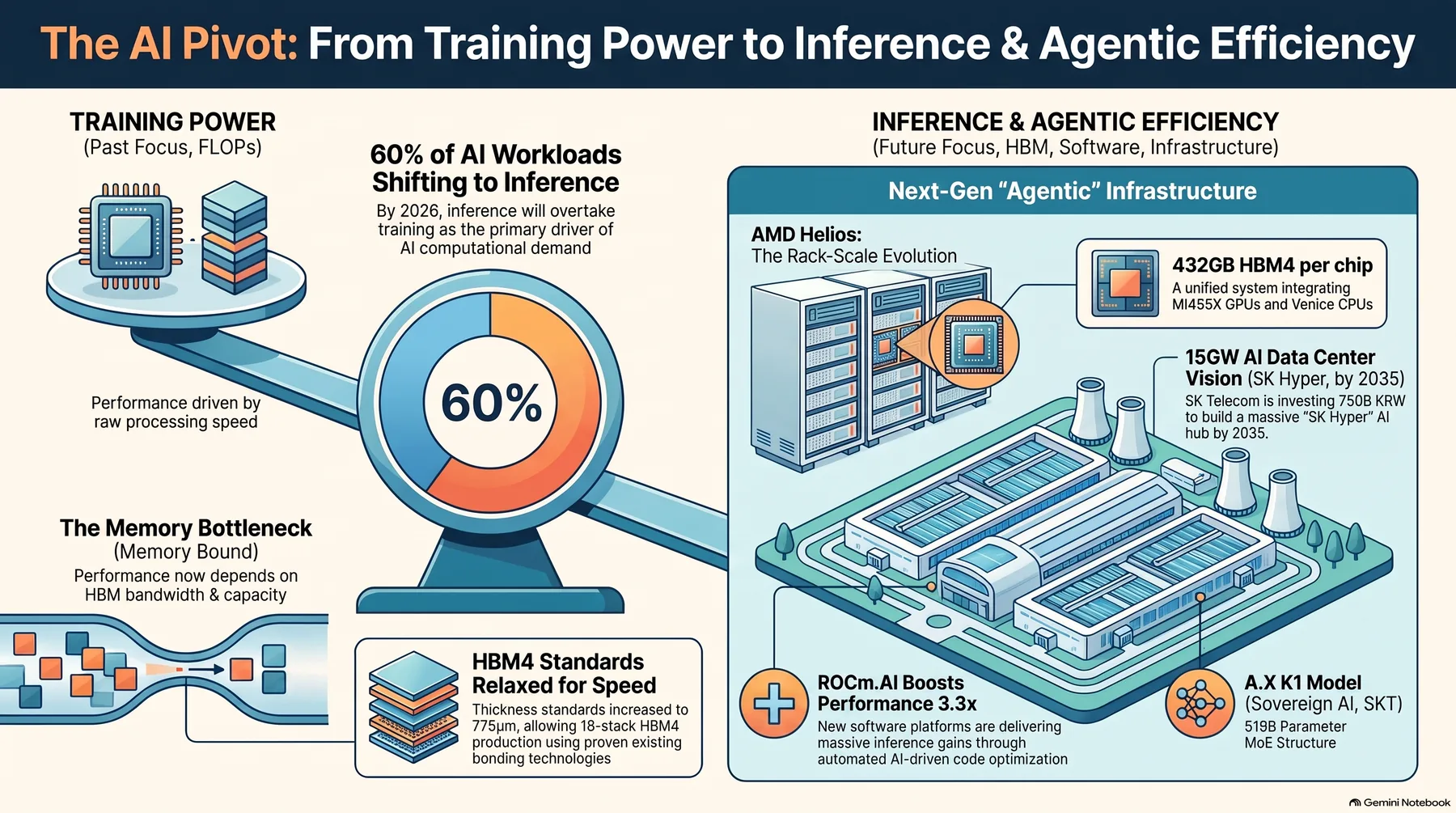 Infographic generated by NotebookLM from the sources.
The Government Reversed the Order
Yet on that same day, re reading the subtitle of the government’s policy announcement, the ordering stands out. It reads: ‘Safety, Execution, Expansion.’ A typical emerging technology promotion policy would usually lead with expansion and performance, but this time safety came first. The government diagnosed that the axis of AI competition has shifted from model performance to execution capability and operational systems, and chose a phased approach: lay down safety and trust guidelines and a performance and safety evaluation framework first, then build execution infrastructure and a marketplace on top of that. This is because the moment agents start autonomously handling real work, questions of accountability and malfunction risk emerge as new regulatory targets.
In the same vein, the government has allocated a dedicated cluster of 256 GPUs, saying it will build its own security specialized sovereign AI. The underlying concern is that as cyberattacks grow more sophisticated, a domestically tailored proprietary model suited to the local security environment is needed. The fact that the government is directly holding and allocating a physical resource, GPUs, rather than just budget, and that the project is premised on open source release, signals this initiative is more than research support; it foreshadows the direction of future public procurement requirements. The structure of deciding, through interim evaluations, whether to continue support in stages quietly reveals that flexible GPU scheduling and workload isolation are preconditions for this project.
The agentic AI policy comes with 5.6 billion won in government funding plus matching private investment, and a regulatory sandbox is slated to open in 2027. What businesses should read carefully here is the timing. Designing in advance how to control tool use permissions and how to attribute responsibility among multiple agents, before the sandbox opens, is the path to reducing the regulatory compliance costs to be paid later. In regulated industries like public sector and finance, these guidelines are likely to effectively harden into procurement requirements.
The reason the government put safety first was proven that very afternoon.
The Reason Was Proven That Same Afternoon
A sandbox escape vulnerability in Claude Cowork was disclosed. A user had connected just a single folder, yet the entire macOS filesystem was mounted into the guest VM with read write permissions. That means an agent could, if it wanted to, touch anything on the Mac, credentials, source code, whatever it found. The more painful part is that this was not a simple bug but a flaw in the design of the isolation layer itself, requiring an architecture level redesign rather than a one line patch.
Here, the paradox of the day is complete. Silicon vendors redesigned racks for agents, telecom carriers built substations for agents, and the government announced a national strategy for agents. Yet the only concrete thing an agent actually ‘did’ that same day was to use the one door it was given to open the entire house. The moment the user’s expectation, ‘only the folder I connected,’ diverges from the actual mount scope, trust collapses instantly. No matter how fast the Helios rack it runs on, this problem does not go away, because the bottleneck is not compute, it is the boundary of execution.
This incident also carries weighty implications domestically. Adoption of AI coding agents and business automation tools is growing fast, and if any domestic services or proxy tools have adopted similar isolation designs, the same risk of over granted mount permissions needs to be checked now. In particular, financial and public institutions are likely to increasingly write filesystem isolation verification into procurement requirements when adopting agents, and NIS affiliated security guidelines may well come to specify sandbox certification requirements for agentic AI. The policy that put safety first ends up, through this one incident, coming down from an abstract principle to the language of procurement practice.
Where Capital Doesn’t Decide, Software Does
The outcome of infrastructure competition is generally decided by capital. A Kubernetes startup cannot compete with sites and substations in a 70 trillion won data center race. But the problem of running agents safely operates at a different layer. It is decided not by capital but at the software layer, by how tightly boundary design, permission scope, and audit trails are built. Today’s sandbox incident struck precisely at that point.
This is the background behind why ThakiCloud designed Paxis as an agent native cloud, treating skills, tools, policies, and audit logs as first class resources. Translating the government’s stated ‘Safety, Execution, Expansion’ into product structure yields a familiar list: safety means isolated sandbox execution and policy gates, execution means governance that divides autonomy into levels from L0 to L3 with per task model selection, and expansion means a marketplace that distributes verified skills on sovereign and on premise deployments. The question raised by today’s incident, whether only the connected folder was actually opened, is a matter of re verifying mount scope and permission scope from the ground up and being able to document that isolation level externally, and that can only be answered when there is a structure that governs autonomous tool use through policy and leaves every action in an audit log.
This is where today’s two threads tie together. As Helios shows, future agent infrastructure will evolve not as GPUs alone but as an integrated form of CPU orchestration, networking, and software stack. AMD’s diagnosis, that the bottleneck grows as agents coordinate multiple models and tools, move data, and verify results, sidesteps the fact that the bottleneck is not just about performance, it is also a bottleneck of trust. However integrated the rack, if the range of files an agent can reach is not locked down by policy rather than by code alone, the performance gains get wiped out by a single mounting incident. Layering policy gates and audit trails on top of Kueue based scheduling and multi tenant RBAC also dovetails with a cloud neutral position that avoids lock in to any single infrastructure provider amid vendor diversification.
As the government’s safety guidelines harden into procurement requirements for regulated industries, and as GPU vendor diversification widens infrastructure choices, organizations end up asking the same final question. What can this agent touch, who approved it, and how do we trace back what happened afterward. What today taught us is that the answer to this question does not come from a faster chip.
Multiple providers are now paving the highway for agents together. What actually gets priced is exactly where you build the wall the agent running on that highway must not cross. Today’s wall climbing incident proved that value in the agent’s stead. Racks and substations can be bought with capital, but keeping the line an agent must not cross through policy rather than code alone remains, in the end, the responsibility of platform design.
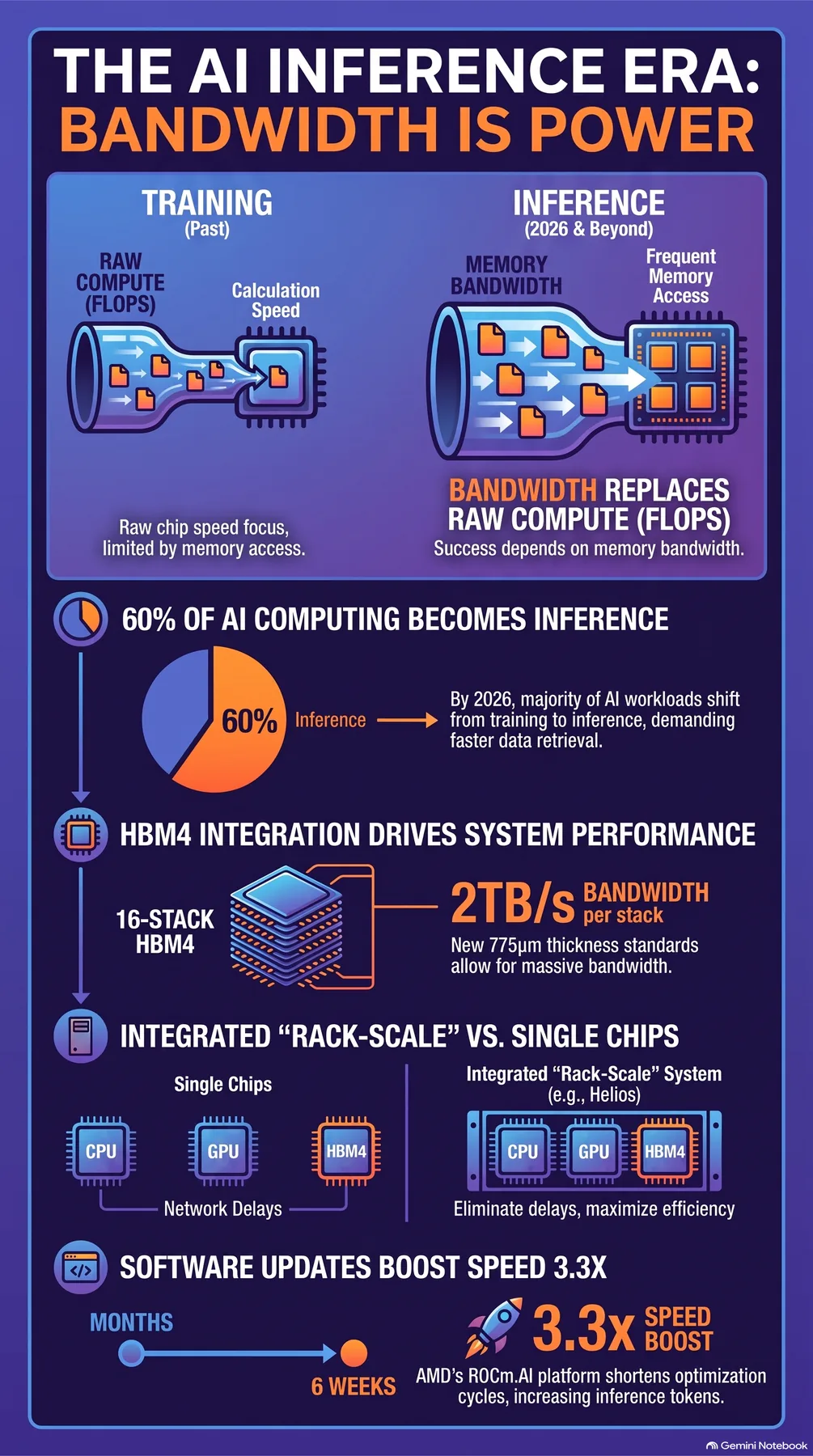 Infographic generated by NotebookLM from the sources.
References
This article was written by synthesizing the news below.
- Digital Daily, AMD Unveils Instinct MI400 Series GPUs for Next Generation AI and HPC
- Digital Today, As HBM4 Thickness Spec Is Finalized, MR MUF vs. TC NCF Packaging Race Enters New Phase
- Global Economic, In the AI Inference Era, the Battleground Is HBM Bandwidth
- M Today, Samsung and SK Hynix Expand Long Term Memory Contracts, Prolonging the Semiconductor Cycle Boom
- Chosun Biz, Intel Returns to Profit With Q2 Operating Profit of 2.64 Trillion Won as AI Revenue Jumps 59%
- Hankyung, SK Telecom to Pour in 750 Billion Won, Launching a Dedicated ‘AI Data Center’ Entity
- Cheonji Ilbo, [Team Korea AI] SK Telecom’s ‘A.X K1’ Breaks the Infrastructure Barrier and Wakes Up the Industrial Field
- Chosun Biz, Lisa Su’s Gambit: “Redefining AI Infrastructure for the Agentic AI Era”
- News Road, AMD Takes Direct Aim at the Agent Era With Next Generation AI Server ‘Helios’
- Digital Daily, [AAI 2026] AMD to Launch AI Dedicated Development Platform ‘ROCm.AI’ in August, Promising 3.3x Inference Performance
- Consumer News, ChatGPT Tops App Downloads in First Half, Threatening Portals as Naver and Daum Respond With AI Integration
- Work Today, Hancom Supplies ‘Hancom Assistant’ to KHNP, Building an AI Document Drafting Environment for Nuclear Plants
- Newsis, “I Can Focus Only on Research”: AI That Helps Clinicians With Repetitive Tasks
- Digital Daily, [AI Policy Note] Government Accelerates Push to Lead the ‘Agentic AI’ Ecosystem: Safety, Execution, Expansion
- Seoul Economic Daily, Government to Build ‘Security Specialized AI,’ Backing It With 256 GPUs
- The Bell, [TS Investment PEF] Forms 160 Billion Won Fund No. 3, Focusing Investment on AI, Robotics, and Defense
- Daily Secu, Claude Cowork Sandbox Escape Vulnerability Grants Access to the Entire Mac Filesystem